Loneliness vs Being Alone

Last night I did something I’d always wanted to do, but had never gotten the chance: I went out to the middle of nowhere (sort of) and watched the Perseid meteor shower. 

  I say sort of because the spot I went wasn’t exactly top secret and quite a few people turned out to see the show.  Still, it was far enough from the city lights to make for a good viewing experience. 

The difference between me and probably everyone else there? I was alone, and I couldn’t have been happier. 

I’m an only child, so I’ve always been fairly content in my own company. I think that’s part of what makes me suited to writing–spending chunks of time in self-imposed solitary confinement doesn’t usually tend to bother me.  Sometimes I actually find it comforting, as I did last night: laying on the hood of my truck, staring up at the stars and watching meteors punctuate the sky like something out of a dream. 

Still, there are times when loneliness creeps in. 

I should explain. A couple of months ago I began living alone for the first time in my life, and even though I said that about being okay with being alone, it’s taking some adjustment to get used to. Since I work so much overtime at my day job I really don’t have a lot of free time, and I generally do pretty good at making the most of it when I do, but sometimes, now that I’m alone anytime I’m not at work…yeah, I get a little lonely, mostly on my days off. 

When I do get bitten by that little bug called loneliness, I try to find something to do that will occupy my time, however mundane it may be. 

(Side note: any fellow writers out there know good and well that any free time should be spent writing and editing, and while I won’t contest that I will say that my writing conditions are far from optimal right now, and it’s made it far more difficult than it used to be for me to get work done. For what it’s worth, I do have a new short story I’m working on, so I’m not at absolute zero on the productivity scale, just pretty low.)

Last night I found myself getting restless and bored and yes, a little lonely, while I killed time until it was late enough to go out and watch the meteor shower. During those intervening hours I wrote an email, played the guitar for the first time in ages, even found myself scouring a rusted cast iron pan in dire need of some TLC. 

It worked, as eventually the time came for me to drive out to the small local observatory where people went to watch the shower. The observatory had special late hours, so I went in and had a look around and took a gander through their giant telescope (a bit disappointing…shhhh, don’t tell them–I don’t want their feelings to be hurt), and took in the variety of people who had turned out for the show. 

  • The bros there with their stereo, a cooler of beer, and some girls, who got more than a little intoxicated by the time they left.
  • The young couple who perhaps thought, as did I, that the spot may be more desolate, providing them a good make-out spot. 
  • The family who parked behind me, with their boy of about 10 who was clearly fascinated with astronomy, and in his excitement had apparently lost the ability to control the volume of his voice. Everyone within a 100 foot radius knew that he knew where the Milky Way was, not to mention a few constellations, and, in one bizarre tangent, the history of the twin towers and the events of 9/11. 

Slowly, one by one they left, until I was practically alone with the insects and the few remaining die hards who I assume were staying out until dawn. That’s when it got peaceful, almost zen-like. It was quite nice. 

Last week I spent a day off doing whatever I wanted, for the most part–a day just for me. I drove around the city (which is not just something I find enjoyable but also helps me with my job as I continually get more familiar with the city’s geography), went to a used bookstore and picked up a couple books, and treated myself to a movie (The Gift if you’re interested, which put an excellent spin on the “crazy stalker” type thriller–highly recommend). Just me and my box of Hot Tamales, and I had a great time, and a great day. Not once did I feel like I needed anyone else to enjoy it more. 

So while I still have the occasional bout of loneliness (like the one I’m currently battling by writing this post), I’m getting good at spending quality time with the guy in the mirror. And that’s good, because he seems like an alright guy–I think I like him. 

The Unbridled Joy of Flipping Off Friends

My workplace is…lenient, shall we say, in regard to language and conduct. Not to say we’re not professional–neigh, we do our jobs and do them well. Dare I say we’re a group of ass kickers who not only perform but thrive under pressure. Perhaps as a bit of a way to blow off steam, our superiors recognized the value in letting us express ourselves largely uncensored. There’s a time and place for filtering what you say and how you say it, but aside from those special occasions, all bets are largely off.

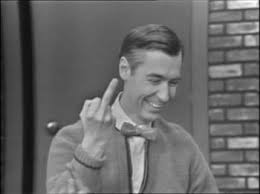
As part of this new freedom of expression that accompanies my job, a few months ago I rediscovered the granddaddy, the reigning champion of hand gestures: the middle finger. The bird. The wonderful, wordless way to tell someone what you really think of them. But unlike a verbal insult, flipping someone off can be more than an offensive suggestion you give to idiot motorists. You can use it to rib your friends in ways that work as well as insulting their mother, and in a much more subtle way (if that’s what you’re going for).

And therein lies the beauty of flipping someone off. Is is childish? Yes. Is it crude? Absolutely. But the variety of ways that crude, childish message can be delivered is staggering. Don’t believe me? Somebody actually wrote a book about it.

http://www.amazon.com/Ways-Flip-Bird-Jason-Joseph/dp/0767926811
Luckily, the people I choose to flip off have a similarly warped sense of humor and take no offense when I call their name under the guise of needing to ask them a question and have a bird perched and ready for them when they turn around. Occasionally I’ll see a co-worker walking my direction and prepare for a quick-draw bird for them so when their eyes glance in the general direction they’ll see it. And sometimes, if the coast is clear, there’s the long distance, office-long bird, flying from one wall to the other before reaching its intended recipient.

Some of my friends are now starting to send the bird flying right back in kind, or, ever more frequently, beating me to the punch. It fills my heart with joy to see an otherwise innocent-looking person hard at work at their desk while simultaneously telling me (wordlessly) to go fuck myself with the slightest of grins from the corner of their mouths.

See, we all understand, in our own brand of lunacy, it’s actually a show of affection—a salute, of sorts, for the truly twisted.

Tomorrow’s Friday, what better day to start a bird watching club of your own? Give it a shot–call out to a friend and let them know how much you care. 

As for my own friends/co-workers, they already know exactly where I stand:

images-1

A Strange Milestone

I had a realization the other day that made me stop and think: it dawned on me that I’m the same age now that my mom was when she passed away. It’s not anything I was keeping track of—I wasn’t marking off the days on a calendar or anything. I’m not even sure how I realized it or what made me think of it—it just kind of dawned on me one day. Needless to say, it was kind of a strange little punch to the gut feeling: seeing where I’m at now, and where she was then. It also led me invariably to more thoughts of my own aging—how things are going and what direction things may take.

In 1991 my mom was 41 and she had me (duh)—a goofy-but-fairly bright 17 year-old high school senior who was trying (successfully) to keep my grades up and (unsuccessfully) to get dates, and looking toward graduation and beyond. Little did I know that before the school year was up I’d be down a parent and life would get turned on its head. Now I look at myself at that same age she was then and it’s crazy to think about.

I know of one other person who lost a parent not long after I did, and while we’re still Facebook friends I haven’t actually had any correspondence with him in years. I wonder if he’s reached that magic number yet, and if it was as weird for him as it was for me. I also have some cousins who lost their mom, too (my aunt), and the oldest is getting close to that age as well, if he hasn’t already hit it. So strange to think about.

On a semi-related topic, I inadvertently wound up as the old guy at work, which has been interesting. I’m far from the oldest person there (other shifts have people that are older), but am in fact the oldest person on my shift, which is weird. I work with really young people—some of which are literally half my age—and it has advantages and disadvantages. On the plus side, I feel at least slightly in tune with younger people, which I’m thankful for because I have story ideas (one in particular, for a book involving a young female protagonist) for young characters, and I don’t want to write a book about a twenty-something year old main character who uses slang expressions from the 90s or sounds like a 41 year-old dude.

On the downside, when the generation gap does rear its ugly head, it can sometimes hit hard. Someone at work asked me about a picture of my old band that was posted on Facebook, and when I told them it was from 1993 or ’94, they replied with, “I was busy being born.” Ouch. Not that I blame them—it comes with the territory. Hell, when I was in my early twenties we used to tease the 26 year-old that hung out with us, telling him how he was going to die sooner than the rest of us, stuff like that. But now, being on the other end of it, it’s surreal.

I really haven’t had much to write about lately and this is the only thing that’s been on my mind and seemed blog-worthy. In all honesty, I’m probably going to dial back to a once or twice a month posting schedule, assuming I don’t retire the blog entirely. Between the job (which I love, but now that I’m full-fledged, so to speak, requires a fair amount of overtime) and the time I need to devote to actual writing and editing (I’ve got novels to finish, people!), spending time on the blog seems like a luxury more than anything. I don’t want to stop it altogether, and I don’t think I could even if I wanted to, because it’s a good feeling knowing at least a few people out there are reading something I write (and the way rejection letters are stacking up it may be awhile before you see any fiction from me again), and writers are needy folk—my ego needs it. So I’ll keep posting as the notion strikes me, hopefully no less than twice a month. Which reminds me: I implore you, if you haven’t already, friend me on Facebook or follow the blog by email. As I post less frequently it will be easier to miss my new posts in the sea of blogs on WordPress.

So, until next time, whenever that is, take care.

Wonderbook: Worth its Weight in Gold

We all had the “cool” teacher in school—do you remember yours? Mine was Coach Mahr (I think that’s how he spelled it). He taught anatomy and physiology, and was also the track/cross country coach at our high school. He was younger than a lot of the other teachers (probably mid-thirties), and could often be seen out on the track, running alongside his team. In the classroom, he was funny and engaging, and his class was a lot of fun. In contrast, my 12th grade English teacher was Mrs. Simons, was an uptight Irish woman who ran a tight ship and made her class dreadfully boring to attend.

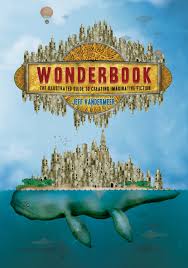
In books about writing, we have Strunk and White on one end of the spectrum (indispensable as it is, The Elements of Style is a bore—stuffy, and a chore to actually try and read), and on the other end, the “cool” one, is Jeff VanderMeer and his awesome writing tutorial Wonderbook: The Illustrated Guide to Creating Imaginative Fiction.

Unknown

Have you ever had the experience of intrinsically knowing something, and the first time you hear or see that something explained a flash bulb goes off in your brain? That’s kind of what reading Wonderbook has been like for me.

See, one of the most common pieces of advice for writers is, ‘you have to read a lot.’ And that’s good advice, because it’s really the only way to see what you do and don’t like, what you think works and what doesn’t, etc. But in the end you pick a lot of those things up almost subconsciously, to the point that you may know what to do but you may not be sure just why (or sometimes, how). Then along comes the amazing, all-knowing wizard Jeff VanderMeer to break it all down for you.

This book explains things I’ve never seen anyone even attempt to explain before (and believe me, I’ve done my share of research and studying). Most writing books lean more to the Strunk and White side of things—a focus on grammar rather than constructing a story. VanderMeer talks about all aspects of creating: from story structure and pacing to character development, and even the act of creating itself, and recognizing and nurturing your own imagination to be your most productive. What’s more, there are a multitude of essays from renowned authors such as Neil Gaiman and George R.R. Martin, to name but a few.

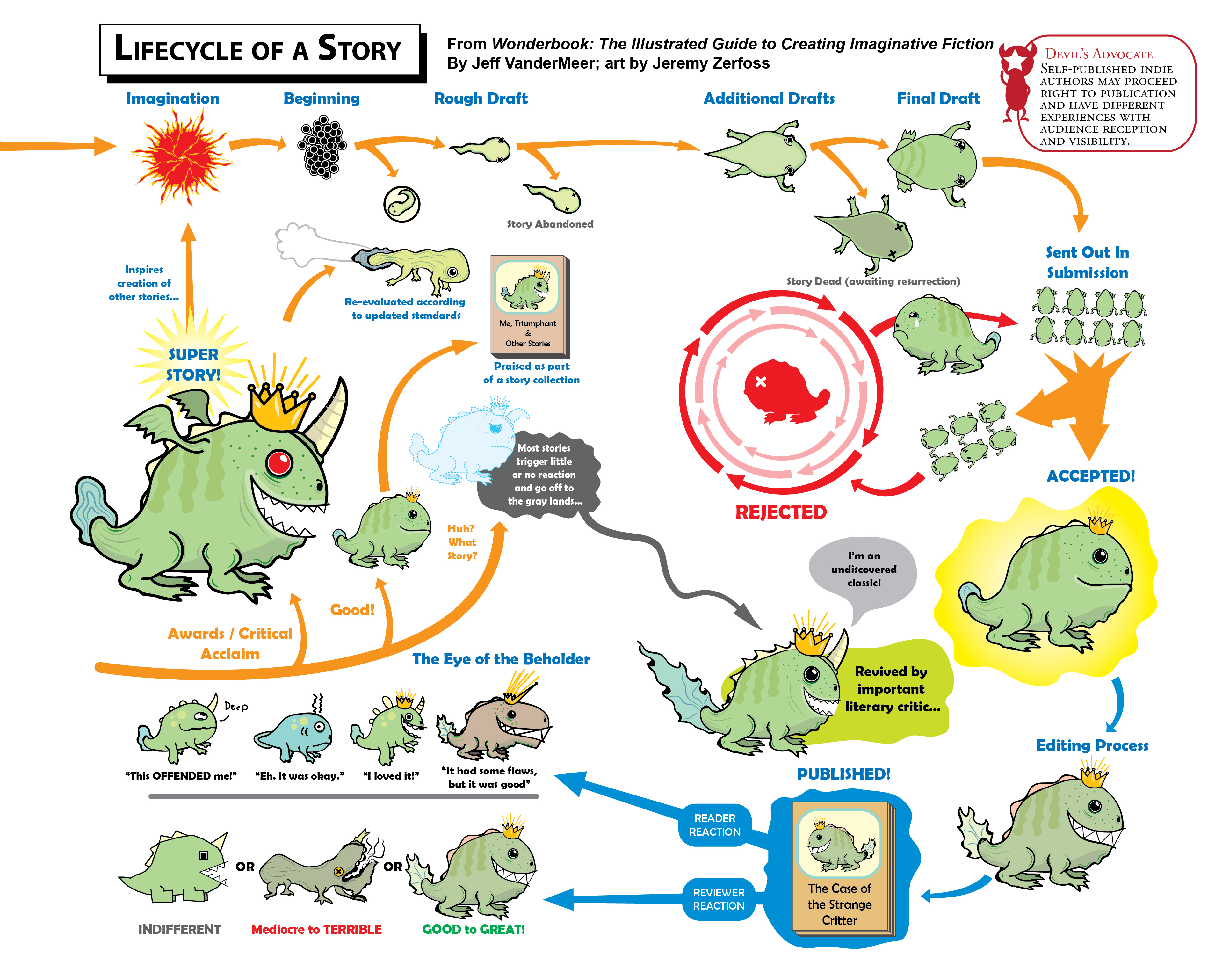
Wonderbook is also chock full of illustrations, some to help drive certain points home, but also just to keep your brain engaged and make the book entertaining. I’m sure I’m probably violating some kind of copyright laws by putting this on my blog, but somehow I think Mr. VanderMeer would be okay with it. It’s one of my favorites:

life-cycle-of-a-story

The book is chock full of similar illustrations, getting even more bizarre and surreal. The book is so densely packed with useful information that within the first few pages I was asking where this marvelous thing had been all my life. It’s also worth noting that I haven’t even finished the book yet. I was going to wait until I was done to write up this piece, but I soon realized I’ll never really “finish” it, because aside from the text, there are also writing exercises and supplemental online content to further the Wonderbook experience. Not to mention the fact that Wonderbook will also serve as a sort of reference manual for me for years to come.

Add to all this the fact that Jeff VanderMeer isn’t just some guy telling other people how to do what he hasn’t had success doing. If you’re not familiar with the name, you may recognize his acclaimed Southern Reach Trilogy—Annihilation, Authority, and Acceptance—which came out to rave reviews last year and are now on track to become a series of movies as well. It gives the advice in Wonderbook a little more weight, somehow.

If you’re a writer or know someone who is (or is thinking about becoming one), they need this book, even if they don’t know it. It’s slightly geared toward fantasy and sci-fi writers, but they’re hardly the only people who will benefit from reading it. I can’t think of a single more useful tool to writers at all levels of competency, and in all genres.

Check it out at amazon here.

A Night of Subverted Expectations

This is a sort of pop culture wrap-up for my Saturday (and again, my Saturday=your Sunday). I finished the book I was reading and my wife and I squeezed in three—count ’em, three—movies, and it turned out to be a mini James Gandolfini marathon. Aside from the movie Thirteen, starring Holly Hunter and a teenage Evan Rachel Wood (which was a good fly-on-the-wall look at a good girl’s turn toward the dark side, and is BOJ certified as recommended, but didn’t knock my socks off), the book and both Gandolfini movies subverted my expectations, for better or for worse. I’ll start with the ‘for worse.’

Unknown-2

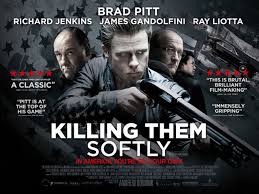
Killing Them Softly had been on our DVR for quite awhile—if you couldn’t tell by now, I’m a sucker for gritty crime drama, noir, hitmen, etc. When you have a cast as strong as this one—Brad Pitt, James Gandolfini, Richard Jenkins, and Ray Liotta—I’m in.

It wasn’t a bad movie by any means, it just seemed to miss the mark a little bit. The plot is as follows: three men are responsible for knocking off an illegal gambling ring, knowing the head of said gambling ring (Liotta) will take the fall. Pitt’s character is brought in by an attorney to the mafia (Jenkins) to figure out what happened, who’s to blame, and who’s going to die. Gandolfini’s character is brought in to help carry out one of the hits.

What seemed like it should’ve been a pretty straightforward plot was unnecessarily messy and hard to follow, ending rather abruptly and leaving my wife and I with questions like, “What happened to ____?” and “Who the hell was _____, anyway?”

It was also a bit heavy-handed with political tie-ins—the movie takes place during the McCain-Obama campaign run, and ends on election night. At the very end it becomes more clear why the tie-ins are there, but it still could’ve been handled with a little more subtlety.

It felt at times like a Tarantino/Scorcese-light kind of movie: aiming high but falling short. If you’re into these kinds of movies like I am I would still give it a go. It’s well-shot (with some stomach-turning graphic violence handled nicely, in my opinion), and well-acted. James Gandolfini is awesome (if ultimately irrelevant to the plot) as the unhinged, unstable hit man brought in to help Pitt’s character. If you don’t typically like these kinds of movies, you probably won’t care much for it.

Unknown-4

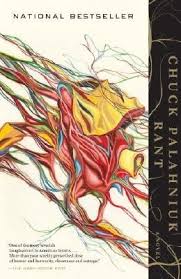
Chuck Palahniuk seems to be what I’d call an “avocado” author: people tend to either love him or hate him. I can’t fully fall on the love side, but I like a lot of his work. I’d heard Rant was really good without really knowing much about the plot at all, so when I got the chance to check out the e-book from my library, I took it.

**(side note: did you all know you could recommend e-books to your local library for them to purchase using the Overdrive app? I don’t know about other cities, but the lovely folks at the Wichita Public Library have bought two books on my recommendation, and I think that’s downright awesome)

It starts as a character study of Buster “Rant” Casey, a backwoods country bumpkin who as a kid has an affinity for getting bitten by insects and vermin, picking his nose and sticking the boogers on his wall, and finding valuable coins.

We follow Rant to an early diploma from high school, where he moves to the city and the story takes a turn into sci-fi territory, as we learn society has been divided between the respected “Daytimers” and the lowly “Nighttimers”, with a strict curfew to keep the two groups from intermingling. Rant falls in with the Nighttimers and into a social circle known as Party Crashers—an organized sort of after-hours demolition derby that takes place on the city streets. To give much more away would ruin the book.

About 2/3 of the way through the book I was interested in the story, but starting to get a little bored. After reading the last third in one long stretch, I felt dizzy. The book goes from taking a turn here or there to spinning like a top until you don’t know up from down, left from right, or father from son.

The “hook” of Rant is in the way the story is told. The official title is Rant: An Oral History of Buster Casey, the key words being ‘an oral history.’ The book constantly changes perspective as different characters give their accounts of the events that unfolded in Rant’s life, sometimes outright contradicting each other. Kind of like a documentary or a special on TV, the way they jump from one talking head to the next. It’s used to great effect, but also made me wonder—

Where’s the line between originality and gimmickry? One of the complaints I hear about Palahniuk is that he’s a gimmick writer, with nearly every novel using some kind of cheesy narrative device to tell the story. There’s no denying he uses different techniques to tell his stories, and I can see the ‘gimmick label’ being applied. The thing is, is it only a gimmick if it doesn’t work?

Pygmy, Palahniuk’s widely hated 2009 novel told via the journal entries of a 13 year-old foreign exchange student/terrorist in badly broken English, is downright tough to read (I think I liked it more than most), and dismissed as a gimmick. Rant, on the other hand, is held in much higher regard, and the ‘oral history’ gimmick isn’t mentioned as much. I don’t necessarily think every book by an author has to have some kind of gimmick to tell its story (I sure hope not, because my storytelling thus far is pretty straight ahead), but wouldn’t the literary world be a boring place if there weren’t people like Palahniuk taking chances with their stories?

Unknown-3

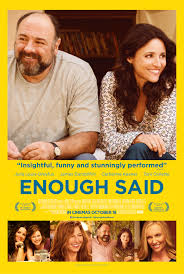
The last subverted expectation was also the most pleasant surprise. I suppose it would come as no shock that I’m not the world’s biggest fan of “chick flicks,” but I try not to discount them altogether, because I know there are some good ones out there. I’ve confessed before my liking for my wife’s favorite chick flick, Return to Me, and last night found one I liked just as well, if not better, with Enough Said.

The film takes what on paper sounds like a fairly standard chick flick or rom com plot—masseuse meets a man and woman separately, begins dating the man and takes on the woman as a client/friend, only to find out they’re ex-husband and wife—and handles it fairly realistically, playing it straight for the most part, but with plenty of chuckles thrown in (and one moment involving a baseball in a drawer that had me laughing so hard I nearly fell out of my chair, thanks to Julia Louis-Dreyfus’s impeccable comedic timing and delivery).

All the characters in the movie felt like real people, not one dimensional and flat or caricatures like in a lot of movies (and books, for that matter), and the dialogue felt realistic and smart. There was also a subplot I liked with Dreyfus’s character subconsciously replacing her daughter, who was preparing to move off to college, with her daughter’s friend. None of the characters were perfect, none of them were total a-holes (although I must admit I didn’t care for Catherine Keener’s ex-wife famous poet character—I’m beginning to wonder if I just don’t like Catherine Keener), they were just fairly normal people with flaws like anybody else. It was well-written and wonderfully acted, and I was glad I watched it. I had expected to look up from Rant every so often to make sure I was following along with the movie, but found myself with my book (phone) in my lap, all my attention devoted to the movie.

 All in all a great night with my favorite person, and a good way to recharge the batteries for writing and some very likely overtime in the coming week.

Resting Dick Face: What It Is and How You Can Help

“What’s wrong?”

“You look like you don’t want to be here today.”

“Somebody got up on the wrong side of the bed this morning.”

We’ve all heard these phrases. Maybe you’ve even used a few of them yourself. But did you know these sayings could be indicators of a crippling affliction affecting a large number of Americans today?

Hi, I’m writer and blogger Kenneth Jobe. You may know me from blog posts such as Minor Annoyances A-Z, the Freshly Pressed The Forgotten Art of Simple Conversation, and the horror anthology Robbed of Sleep, Volume 2, now available in paperback and e-book format. I’m here today to talk to you about a largely unspoken disease wreaking havoc on the unfortunate souls who suffer from it. These poor men are victims of unabashed stereotyping, some even being shunned from social circles due to their devastating illness.

What could cause such emotional turmoil for so many men?

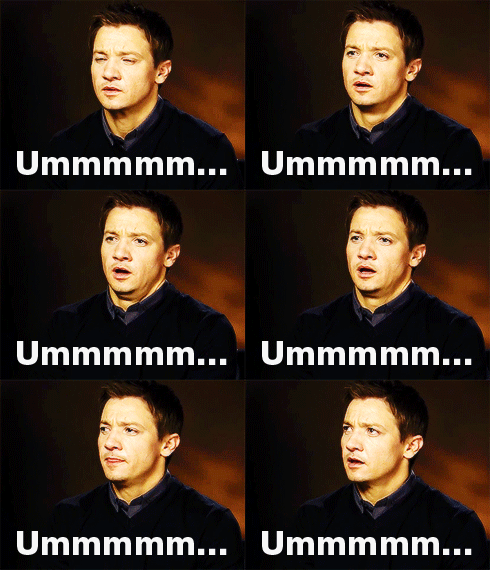
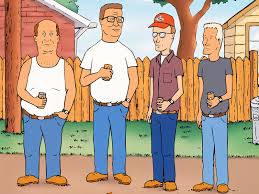
images

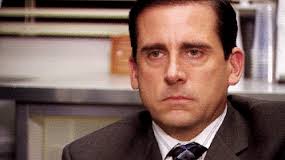
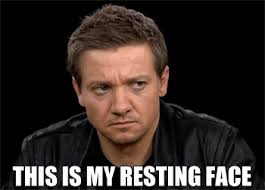
Resting Dick Face is a very real, totally not made up condition affecting millions of men annually. Also known as Resting Douche Face, Resting Bitch Face for Men, and God, That Guy Looks Like a Real Dick, RDF can have a multitude of negative side effects.

I know what you’re thinking—But Ken, how do I know if I or someone I love suffers from RDF?

First of all, don’t call me Ken like we’re friends. Second, that’s a very good question with no easy answer. To help you determine if a loved one might have RDF, I’ve come up with a series of questions that help make it easier to identify and diagnose:

Does the man you suspect of having RDF have more than one facial expression?

Is one of those expressions a smile or laughter?

Is the man in question generally a nice guy despite the look on his face?

If you answered yes to 2 out of those 3 questions, you may in fact know someone battling RDF.

Okay, I know someone with RDF—how do I act around them?

This can be tricky. Treating someone who’s different like they’re normal is never easy. Take it from me, I should know—I’m a white male. To help you, I’ve included this simple guide to Living with Someone Living with RDF.

Do you like the person who has RDF and typically enjoy their company?

Yes: Treat them as if they don’t look like someone has urinated in their cereal bowl. Maybe even greet them with a smile or friendly gesture to help ward off their current case of RDF.

No: Avoid eye contact and all social interaction.

I know what some of you out there may be asking yourselves: I think I smile and look pleasant most of the time, but people still seem to avoid me, even after striking up a conversation. Some people even roll their eyes when they see me or walk away from me when I approach. I don’t know what their problem could be, I just tell it like it is. Is my RDF more serious?

It’s unfortunate you have to find out this way, and I wish there was another way to break it to you, but it’s time for you to face facts—you’re just a dick. BooksOfJobe Publications is currently hard at work on a Guide to Ending Dickish Behavior, but in the meantime, the best advice is to try to get your life together and stop being such a massive dick.

How do you know so much about RDF?

This may come as a surprise to many of you, since you don’t actually see my face up close and personal and my blog makes it clear that I’m an all around awesome individual,  but people close to me already know the shocking truth: I suffer from RDF.

I’m lucky—my case is strictly mild-to-moderate RDF, but it can still strike without warning, and still be quite devastating. As a matter of fact, this Public Service Announcement was brought about when I was self-diagnosed with RDF less than a week ago, after arriving at work in a pleasant mood and being greeted with a bevy of comments ranging from, “He looks thrilled to be here today,” met with “Yeah, I can tell,” to “You look like you’re so over today.”

Unknown-3

It was then that I began my journey of self-discovery and realized how many poor souls out there need our help. If you know someone with RDF, don’t let them suffer alone. Engage them in conversation, pay them a compliment, or make them laugh, and help them ward off their current case of RDF. If you encounter a man with RDF in the wild, don’t be afraid. Approach him with the same caution you would exercise when approaching any man you don’t know. If, after a few minutes of conversation, the man’s expression hasn’t changed and they don’t warm up to you, have no fear—you’ve just encountered a dick. You may exit the conversation at your earliest convenience.

For the men who suffer from it, RDF is an uphill battle, but together we can win the war. I’ve started a charity, the Fund for Understanding and Collective Knowledge, and our top priority is eliminating RDF from the male populace. Please consider a modest donation—every dollar helps.

Click here to donate to the Fund for Understanding and Collective Knowledge

Get to the point already!

Taking a break from rewrites today for two reasons: 1) the synapses just aren’t all firing—chalk it up to exhaustion following a busy work week (I’m writing this on my Saturday, which is Sunday for you M-F’ers, even though you’ll be reading it on your Monday, which is my Sunday, got it?), and 2) I don’t want to neglect the blog, so when I got an idea for a post I decided to hurry and write it up.

I haven’t written anything new for quite a while. I’m still trying to get the same batch of 4 short stories published (the oldest of which has been bouncing around for almost a year now), considering final tweaks on novel #1 before finally calling it officially done (I recently had a light bulb moment regarding the final act and may have to rewrite some of the book’s climax), and rewriting novel #2 (#1=Snakebit and #2=Liberating Oz, for those of you keeping score at home). What this means is that I’ve been in an editing frame of mind for quite a while, and will be for at least a couple more months.

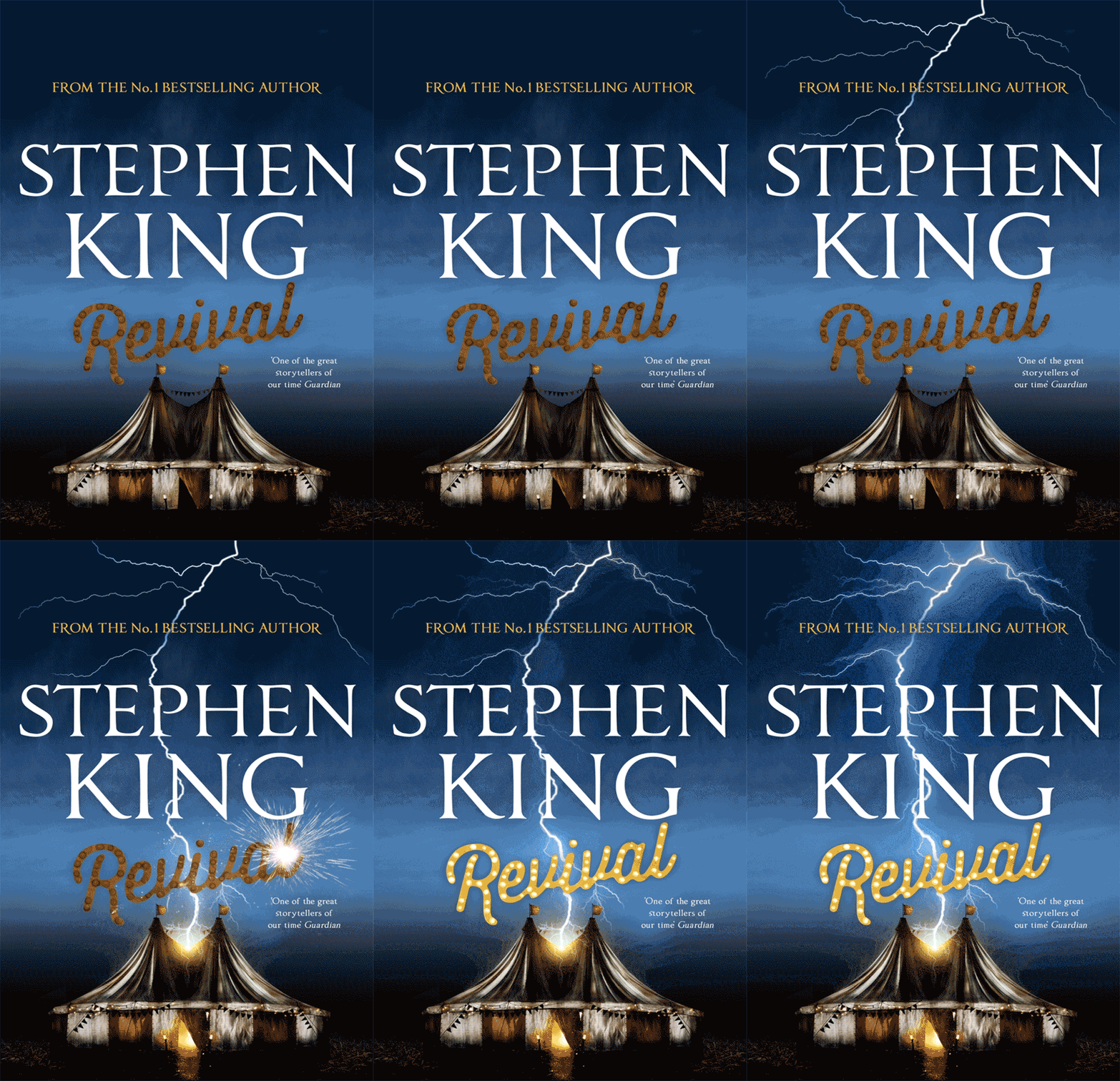
On top of that, I just finished Stephen King’s latest novel, Revival, and had a brief discussion on Facebook with my friend and fellow writer (as well as my go-to movie and music expert) Jeff, in which we agreed that Mr. King has an issue with being excessively wordy and needs to keep someone around to tell him when it’s time to cut the crap and get to the point.

How cool is that? Also, if anyone cares, this is an alternate cover, of which there were several, all of them cooler than the official US cover, in my opinion.
How cool is this? This is an animated GIF of an alternate cover, of which there were several, all of them cooler than the official US cover, in my opinion.

I’m not going to get into the specifics of Revival, but it’s by no means a bad book. The first third or so had me riveted as I waited patiently to see how all the backstory would pay off. And the ending was quite good, if you like things dark and twisted like I do. Especially coming from King, it was a satisfying (which in this case means unsettling) ending, and yet I was still a little frustrated when I finished it. Because the rest of it—from about 1/3 of the way through until the last 30 pages or so? Ugh. It was still interesting, at least to me as a musician, but it started to drag on, and on, AND ON, until I started thinking, ‘Good God, when is something going to finally happen?’

A brief word about my job (it ties in, trust me): I’ve completed training and am now a full-fledged Fire and EMS dispatcher, so when calls come in for medical and/or fire-related emergencies, I’m one of the people going out on the radio and telling the units where to go and what’s going on there. It can be stressful (and is, fairly regularly), but it’s actually also a boatload of fun, if you can believe that. But the thing is, among all that chaos I still have to take 911 calls as well and juggle all of it simultaneously. What this has meant is that when I’m on the phone with a caller I have a newfound sense of urgency—I need to get the pertinent information and get off the phone as quick as I can so I’m available on the radio if units need to tell me or ask me something. I feel like a lot of writers could benefit from having a similar sense of urgency in telling their stories.

Elmore Leonard had the advice that aspiring writers have probably read a thousand times, “Try and leave out the parts that readers skip.” I wish more writers would take that advice. Now, I’m not opposed to taking some time to give some backstory, or maybe a lot of attention to detail in certain scenes if it’s called for, but for the most part I like stories that cut to the chase and keep the ball rolling, like that big boulder at the beginning of Raiders of the Lost Ark.

images

Liberating Oz is written in the first person, and it’s the first extended piece (meaning longer than a short story) I’ve written from that POV. The fist third-to-half of the book is setting up events that unfold in the second half, and for some reason it feels at times like I’m rambling and not staying on task when telling the story. Deep down, I don’t really think I am (I won’t know for sure until I sit down with my reading cap on versus my writing/editing cap), after all the thing’s barely novel-length as it is, but still, I wonder. In my conversation with Jeff about Revival, I said to him, “It would’ve made a killer novella.” I don’t want the same thing said about my own work. I’d rather write a killer novella than a too-long novel that bores people.

Writers out there: do you ever have any issues with feeling like you’re taking too long to get to where you’re going, be it first or third person? How do you keep yourself on the straight and narrow?

Readers out there: what books can you think of that lost you along the way because they just took too long to get to the point? Or, conversely, what books got right to it like a gunshot and had you riveted from start to finish?

Until next time, I’m off to do a little reading, once I decide which of the remaining books I got for Christmas is next. What a nice problem to have.

In Defense of Amy Winehouse

Her reputation preceded her—in my case, anyway. I was vaguely aware of “Rehab” and thought it was catchy, but it seemed like a gimmicky novelty song playing on people’s nostalgia of the old girl groups of the sixties. I liked the rebelliousness of the lyrics, though as time went on it became clear that rebellious or not, she needed help.

Before long, images of her reckless behavior flooded the media. That was the Amy Winehouse I thought I knew. The druggie. The drunk. The trainwreck. People enjoyed bashing her—for how awful she looked, for how strung out she was, for her penchant for getting into trouble. Admittedly, she was an easy target. Then, in 2011, she played with fire for the last time and died as a result of alcohol poisoning. Hardly a surprise. Another musician who can’t handle their addiction bites the dust, right?

Then I heard her music.

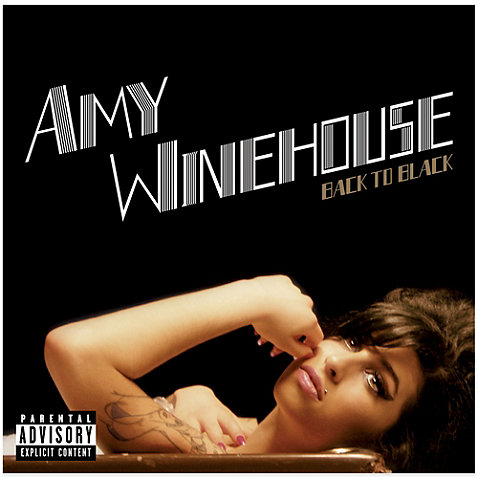
47152943025862p

I’m not sure how I came to hear the quote-unquote ‘real’ Amy Winehouse (by which I mean a song other than Rehab). It might’ve been because I had discovered Sharon Jones, and found out that her backing band, The Dap-Kings, played on Winehouse’s massive hit (and final) album, Back to Black. All I know is, when I pressed play on that first song (I wasn’t listening in chronological order—it was either Love is a Losing Game or You Know I’m No Good) everything else faded away. The world stopped turning for a minute while I sat entranced by the voice coming through the speakers.

“My God, THIS is Amy Winehouse?”

Granted, listening to her music posthumously gives it a haunting, verging-on-tragic edge that it might not have had when she was alive, but the fact remains her voice was simply amazing. Hearing her music, not just the one single I’d already heard, I finally understood what the big deal was all about.

Unfortunately, there are still a lot of people who don’t. A simple google search of her name returns as many links detailing her struggles with addiction as to her music itself. Where do we draw the line, between remembering someone’s contributions in the name of art rather than simply remembering the mess they made of their lives? Is it because her struggles were so public?

That’s the thing that’s gets me about her detractors—if you like music art of any kind, chances are strong that at least some of what you like was created by some truly screwed up individuals. The list of actors, writers, and musicians, etc. who are/were addicts or alcoholics is staggering. I started researching so I could list a few here, and the list was overwhelming. Everyone from heroin-addicted jazz musicians to Edgar Allen Poe to painter Thomas Kinkade, who died as a result mixing copious amounts of alcohol and valium.

Who would've guessed The Painter of Light battled with demons?
Who would’ve guessed The Painter of Light battled with demons?

Eventually, I’m confident time will take care of it. Maybe it’s already starting to. That’s one thing about art: it stands the test of time. Although it’s true that Amy found fame in the modern age of paparazzi and images of her being extremely messed up are all over the internet, people will care less and less about that as time goes on. Her music will still be there, and will still be amazing.

Even though her contribution to the world of music is relatively small at only two albums, it seems we should give her the same respect we give others who have fought and lost their own battles (Whitney Houston comes to mind). People should be defined by the art they gave the world, not the mess their personal lives may have been in the process.

And who knows, maybe she doesn’t need defending at all. Or, maybe the people out there who have no respect for her never will, and trying to defend her to those people is an exercise if futility. But if you only know the tabloid persona and you’ve never actually heard her music, forget what you think you know and give her a chance.

If you want a retro sixties vibe, stream Back to Black. If you’re more of the jazz persuasion, try her astounding debut (recorded when she was just 19 years old), Frank. If you don’t have that kind of time and just want to check out a single song or two, go back up and check out the other links. She wrote the majority of her own songs, and was a lot more than just a girl with a beehive hairdo, crazy eye makeup, and a substance abuse problem. She was an artist. Hopefully that’s how she’ll be remembered.

“It’s about 250 pages.”

As I look ahead to having an actual completed novel—which isn’t a case of counting my chickens before they’re hatched, I don’t think, but rather anticipating what’s to come—there are a few things I have to do that are deceptively difficult. For the most part, they all revolve around one basic question:

“What’s your book about?”

giphy

That’s a fair enough question, and one any writer worth their salt should be able to answer (and answer well) in a sentence or two. Believe it or not, that’s not always as easy as it sounds. Take my near-completed novel (which, by the way, has the tentative title Snakebit):

It’s about Jimmy Ray Day, a repo man/enforcer-type guy who works for a crooked car dealer, who’s given a hit to carry out, but he botches the hit in the worst possible way and finds himself on the run from his boss, headed to Mexico with a duffel bag full of cash and cocaine, where he meets a gorgeous (and possibly mentally unstable) young woman who he falls for hard and fast.

Technically that is just one sentence, but it’s a humdinger of a run-on, and that’s just the first half of the book, neglecting to mention anything that happens from that point forward. After spending months (on the conservative side) writing 60,000 + words, trying to summarize it in a few paragraphs or a couple of sentences is pretty hard to do.

But I have to figure it out, because like I said at the beginning, that’s what’s coming up. You have to be able to hook people, make them want to read the book, in a sentence or two—that’s called the “elevator pitch.”

You get it, right? Like, you step onto an elevator and someone else steps on with you (let’s say a forty-something woman in crisp business attire). You exchange pleasantries and you mention you’re a writer (since all writers are so naturally outgoing), and she says, “Is that right? I’m an editor at XXX books.” The elevator starts going up and you realize you have until she gets off the elevator to sell her on your book.

You need to have something ready, something you can say without going, “Okay well…so, there’s this guy, right? He’s like, a criminal, but not really a bad guy, you know? So anyway, this thing comes up, and he doesn’t want to do it but he knows he has to…but he messes it up, and…”

No. You need to spout out a couple sentences that explain who the main character is, what the conflict in the story is, and why it’s compelling.

Then, along with the elevator pitch is the dreaded query letter. A query letter is a one page letter that you send either to publishers, editors, or agents to convince them that your book is awesome and you are awesome and everything you do is awesome (in other words, a completely factual document).

Part of the query letter is listing any publishing credentials, which, luckily, I have a few (although I could stand a few more, ya hear me editors who currently have my submissions?). But the most critical part is the synopsis, where (you guessed it) you spend anywhere from one to three paragraphs explaining what your book’s about and making the person reading the query letter want to read (and therefore, publish or try to publish) your book.

Luckily, there are more articles about and examples of query letters than you can shake a stick at. Also, my second novel (tentatively titled Liberating Oz, BTW), whenever it’s finished (I’m trying to stay realistic and just stick with an end of the year goal), has a much simpler plot and a much clearer hook, so I don’t think that one will present the same challenges.

And so, while I try to rectify a short story that’s a great idea at its core but just isn’t working for some reason, prepare to start a second draft of Oz that’s basically a rewrite, and wait for feedback from Snakebit’s beta readers, I’ll also be looking at query letters, maybe hammering out a draft or two of them, and looking for publishers to send them to.

You writers out there—do you have any trouble summarizing your work into a quick hook? What’s been your experience with query letters?

Yep.

Ever been talking with someone and the conversation seems to just sort of grind to a halt? Not necessarily an uncomfortable one, but it just seems like there’s nothing more to say for the time being? I think this is the blog equivalent of that.

Yep.
Yep.

I’m going through something of an identity crisis, I suppose. Nothing seems a) important enough or b) timely enough to put on the site anymore. When I started, I was watching a ton more TV and movies and could easily fill my blog with reviews or news of upcoming shows. A change in my work schedule and more time spent actually writing has meant a serious decrease in TV viewing, so I really don’t have that to fall back on now.

Gone-Girl3

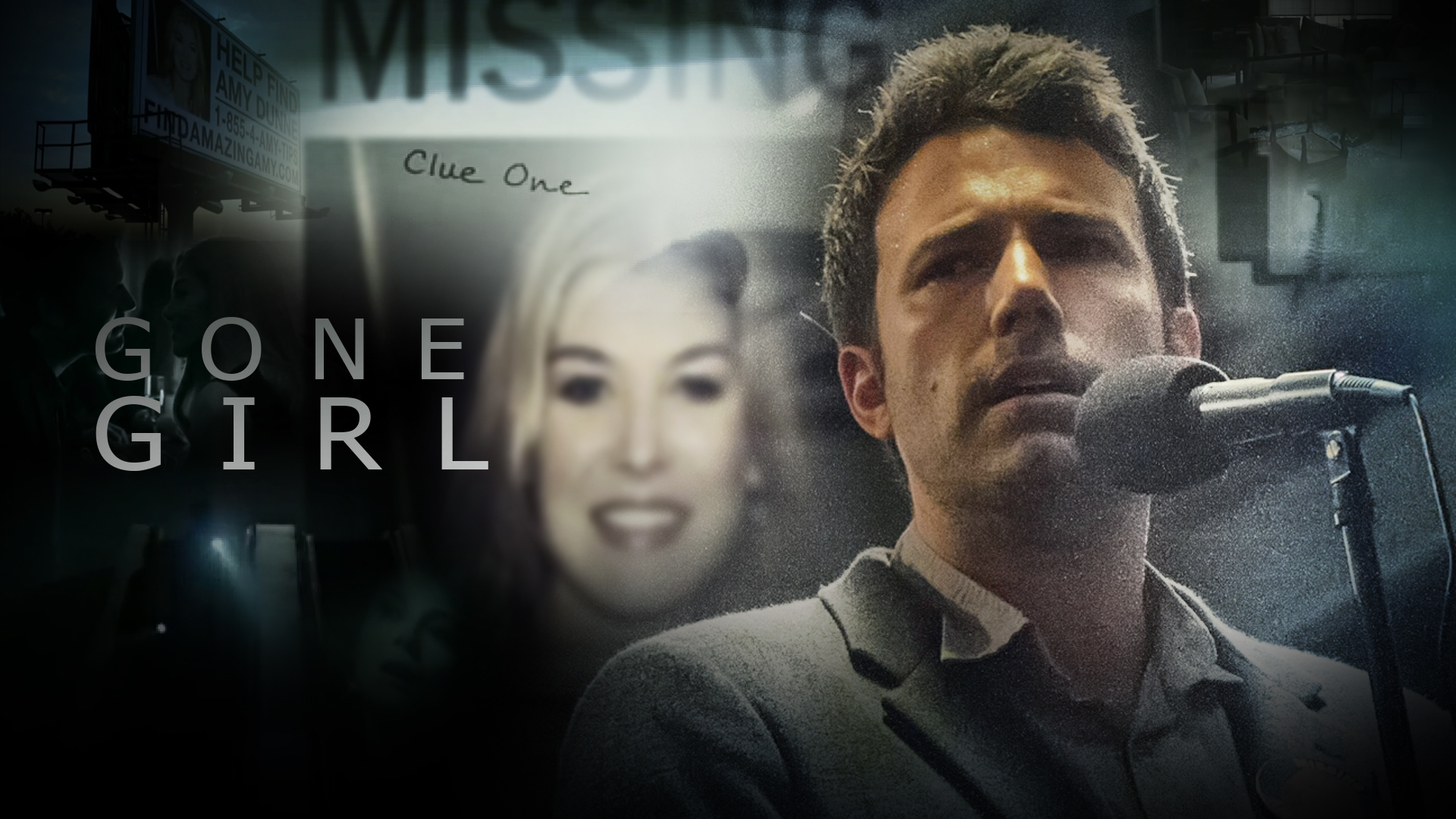
For example: I just watched Gone Girl. I thought maybe I could devote a post either to a full-fledged review of the film, or a comparison of the book vs the film. Then I thought, isn’t it a little late to be talking about it? I mean, I’ll tell you what I thought of it, but to spend a few hundred words on a movie that came out several months ago seems a little late.

Anyway, regarding the movie: I liked it a lot, and thought it was just as good as—if not better than—the book. The things that didn’t make the film were pretty minor, and Gillian Flynn did a pretty excellent job adapting her novel for the screen. As much as I like Trent Reznor’s work, I felt like in some scenes the music was a distraction from what was going on. When Nick and Amy were having a huge blow-out fight, hearing a film score under it (even a somewhat ominous one) took me out of the scene.

The real highlight of the film for me was Rosamund Pike. I literally can’t think of anyone who could’ve pulled off Amazing Amy so perfectly. Cold, calculating, psychotic…her performance was awesome. I don’t know whether or not she’ll win the Oscar, but I think she definitely deserved the nomination.

Want a Netflix recommendation? I’ve got one of those I can throw your way.

Unknown-2

If you’ve never heard of Better Off Ted, you’re not alone. It was only on for two very low-rated seasons on ABC back in the days of yore (2009-2010) when people still watched TV primarily on TV instead of their devices. Take it from me, though, this show is hilarious.

Part romantic workplace comedy, part biting satire of corporate America, and part screwball comedy, how this show never caught on is one of life’s biggest mysteries (because I don’t use my brain to think about things like science or the universe). Once I saw the show was on Netflix I went back to re-watch what I remembered to be my favorite episode and it totally held up, so a BOT marathon may be in the works.

If you’re going to give it a shot and want one episode to see if you like it, I point to “Racial Sensitivity” from season one. The show is set at the headquarters of megacorporation Veridian Dynamics, a sort of SC Johnson or Glad type industry giant, and in a cost-saving measure all the lights, elevators, water fountains, etc. in the building are replaced with motion-sensors that turn off automatically when not in use. The problem? The sensors are defective, and do not detect light reflected off darker skin tones—i.e., they don’t work for black people. The solution? Replacing all the sensors is initially deemed too expensive, so as a temporary fix the company hires a bunch of white people, paying them minimum wage to follow the black people everywhere.

Exchange between Ted and his boss (and company puppet) Veronica:

Ted: “The sensors don’t see black people? …That’s racist!”

Veronica: “The company’s position is that it’s actually the opposite of racist, because the system isn’t targeting black people, it’s just ignoring them. They insist the worst people can call it is indifferent.”

As I write I get more anxious to go back and re-watch the whole series—it really is that good. Give it a shot!

And now, I submit the BOJ suggestion box. Like I said at the top, topics for blog posts are getting a little thin. I have a few ideas, but I’m open to ideas. Soon I should have more writing-related things to talk about as I move from the actual writing of my first novel to trying to get it published, so there’ll be some material there, but what else?

One thing I’ve been bouncing around is a series of “In Defense of…” posts, where I defend something in pop culture that’s either (unjustly) unpopular or was overlooked by the population at large. I may start the first installment of that next week if I don’t think of anything else. So, if you have ideas, suggestions, feedback, whatever it may be, feel free to let me know. What kinds of things would you like to see discussed here?